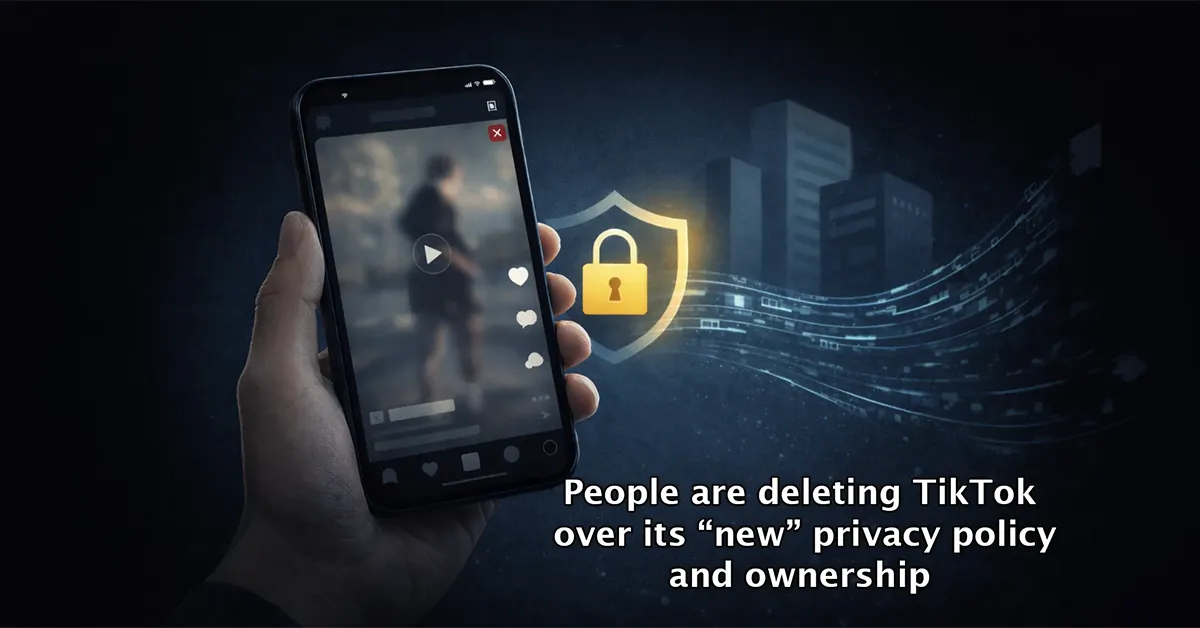
People are deleting TikTok over its “new” privacy policy and ownership — what changed, what didn’t, and what to do next
A TikTok deal meant to calm U.S. privacy and national security worries has produced an extremely 2026 outcome: a backlash about… privacy and trust. The image you shared sums it up: users say they’re deleting TikTok because of its new privacy policy and new ownership structure.
This isn’t just vibes. Multiple reports say U.S. deletions spiked after TikTok’s U.S. operations shifted into a new majority-U.S. owned structure—and right around the time users were prompted to accept updated terms and privacy disclosures.
Let’s break down what’s actually happening without turning it into a “delete everything and move to the woods” sermon.
What happened with TikTok’s ownership
In late January 2026, TikTok announced a new U.S. entity—TikTok USDS Joint Venture LLC—as part of a deal designed to keep TikTok operating in the U.S. while addressing government concerns about data and foreign influence.
Coverage of the deal describes a majority U.S. ownership/oversight structure, with ByteDance retaining a minority stake (kept under a 20% threshold referenced in some reporting).
That sounds like “problem solved,” right? Not quite—because trust isn’t only about who owns shares. It’s also about what the app can collect and how it can use it.
What changed in the privacy policy that spooked people
The biggest driver of the “why are people deleting?” conversation is the updated privacy policy language that users encountered after the ownership transition. One widely cited breakdown highlights three major expansions/clarifications:
-
Precise location data (GPS-level) if users allow location services (more explicit/expanded than prior language emphasizing approximate location).
-
Tracking interactions with TikTok’s AI tools (collecting prompts, generated outputs, and related metadata).
-
Broader ad targeting/data-sharing ecosystem (using data to serve ads beyond TikTok itself, involving advertisers/publishers/measurement partners).
There’s also reporting that the policy now lists categories of “sensitive” personal information it may process (including items like citizenship/immigration status), with the caveat that some disclosures can be driven by legal requirements to list data categories a company may handle if provided or inferred.
To a normal person reading a privacy policy at 1:13 a.m., this can feel like:
“Wait… you want more data after you told us the deal was about privacy?”
That perceived contradiction is gasoline on a trust fire.
Why deletions rose now, specifically
Reports point to a mix of factors piling up at once:
-
Terms/policy prompt timing: users were asked to accept updated policies right after the ownership shift—so the change felt sudden and consequential.
-
Confusion about what the deal actually fixes: some analysts argue ownership changes don’t automatically solve broader data privacy problems that apply across the ad-tech ecosystem.
-
Platform trust wobble: separate reports described glitches/technical issues and claims about content moderation changes around the transition, which can amplify suspicion even if unrelated.
In short: when people already feel uneasy, any change reads like proof.
What the policy language does and doesn’t mean
A key nuance: privacy policies often describe what a company may collect or process under certain settings—even if many users never enable those features.
-
If you don’t grant location permission, GPS collection typically can’t happen (though apps can still infer approximate location through other signals).
-
If you don’t use AI features, you won’t generate AI prompt data (but the policy may still reserve rights if you do).
-
If you do use the app normally, targeted advertising and measurement is usually part of the bargain across most major platforms.
That said, the backlash isn’t irrational. Expanded permissions + broader ad network language = a reasonable “wait, what?” moment.
The practical part: if you’re concerned, do this (no grand gestures required)
If your goal is “less data, more control,” you don’t have to go full digital monk. You can tighten the screws:
1) Turn off precise location
-
Phone settings → TikTok → Location → Never or While Using + disable Precise Location (if your phone offers it).
2) Review ad personalization settings
-
Inside TikTok settings (and your phone’s ad tracking settings), reduce personalization where possible.
3) Limit permissions
-
Photos, contacts, microphone, Bluetooth—only enable what you actually use.
4) Use TikTok in a “low-data” way
-
Don’t connect contacts.
-
Don’t upload your entire camera roll.
-
Avoid linking extra accounts if you don’t need them.
5) If you want a clean break, delete intelligently
If you’re deleting for privacy reasons, consider: uninstalling reduces casual tracking, but account deletion (if you choose it) is a separate step on most platforms.
(Not legal advice—just general digital hygiene.)
So… is deleting TikTok “overreacting”?
Not necessarily. It depends on your risk tolerance:
-
If you’re a creator, small business, or someone whose community lives there, you may choose permission lockdown over deletion.
-
If you’re done with targeted ads, platform drift, or “terms changed again,” deleting is a valid boundary.
-
If your concern is “TikTok is uniquely bad,” remember: many mainstream apps collect a lot of data—TikTok is just getting the spotlight right now.
The more accurate framing is: this is a trust and transparency moment, not just a TikTok moment.


latest video

news via inbox
Nulla turp dis cursus. Integer liberos euismod pretium faucibua