
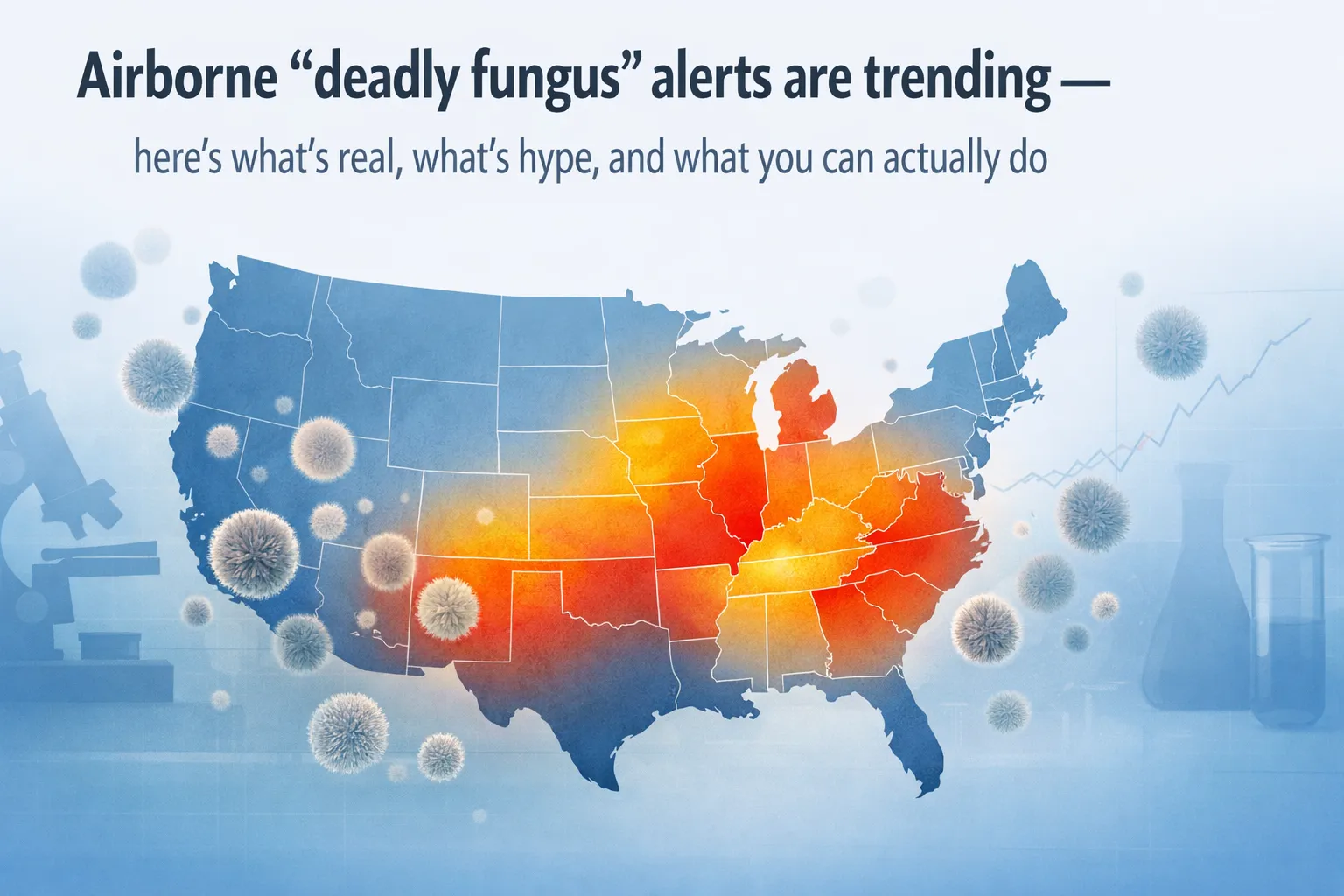
Airborne “deadly fungus” alerts are trending — here’s what’s real, what’s hype, and what you can actually do
A map lights up. A headline says “rising infections” and “deadly fungus.” Social feeds do what they do best: compress a complicated public-health story into a single feeling—uh oh.
The post you shared points to an airborne mold that “rarely stays harmless,” with several U.S. states “on alert.” That framing isn’t totally off-base, but it’s missing the nuance that matters: most people inhale mold spores daily and never get sick, while a smaller, vulnerable group can face serious illness.
So let’s translate the scary headline into plain English, keep it entertaining, and stay fair to the evidence.
First: which “deadly airborne fungus” are we talking about?
In these viral “airborne fungus” stories, the usual suspect is Aspergillus fumigatus—a common environmental mold that can cause aspergillosis, especially in people whose immune defenses are already compromised. The CDC notes that Aspergillus spores are common indoors and outdoors and that it may not be possible to completely avoid breathing them in.
This matters because the post’s tone can make it sound like the fungus is a new creature crawling out of a lab vent. In reality, Aspergillus is basically everywhere—the risk comes from who gets exposed, how much, and in what condition their lungs/immune system are.
Also worth noting: there’s another fungus that gets “deadly” headlines a lot—Candida auris—but it’s mainly a healthcare-associated, drug-resistant yeast that spreads through contact and surfaces, not typically as an airborne outdoor mold. The CDC has flagged it as an urgent antimicrobial resistance threat in healthcare settings.
So when a headline says “deadly fungus,” always ask: Which fungus? Where is it spreading—outside or in hospitals? And who is actually at risk?
Why are some states “on alert”?
Most map-based stories are trying to show where conditions may favor more exposure or more reported infections—often warmer, humid regions or places with lots of dust/soil disruption. Some reports specifically call out warm, wet states such as Florida, Louisiana, Texas, Georgia, and California as areas of concern in recent coverage.
But a key nuance: “on alert” doesn’t always mean “outbreak like a movie.” It can mean:
-
clinicians are being told to consider fungal infection earlier
-
hospitals are tightening infection control
-
public health teams are monitoring reporting trends
-
researchers are tracking how climate and land use might shift fungal ranges
How can a mold be “harmless” to one person and dangerous to another?
Because fungi are opportunists. They’re like that one acquaintance who’s fine at brunch but becomes unhinged at an open bar.
The CDC explains that for most healthy people, breathing in Aspergillus spores isn’t harmful, but people with weakened immune systems are at higher risk.
Higher-risk groups often include:
-
people undergoing chemotherapy or organ transplants
-
people on long-term steroids or immunosuppressive meds
-
people with severe lung disease (COPD, advanced asthma, cystic fibrosis)
-
some critically ill ICU patients
For these groups, the most severe form—invasive aspergillosis—can begin in the lungs and spread, and symptoms can include fever, cough, chest pain, coughing up blood, and shortness of breath.
Why fungal infections are getting more attention lately
It’s not just “the internet discovered mold.” There are real drivers pushing fungi into the spotlight:
-
More people are immunocompromised than in past decades
Modern medicine saves lives with transplants, cancer therapies, and advanced ICU care—but those same patients can be more vulnerable to opportunistic infections. -
Antifungal resistance is a growing concern
The World Health Organization published its first Fungal Priority Pathogens List to steer research and policy—placing Aspergillus fumigatus and Candida auris in its critical priority group. -
Environment + climate factors may shift exposure patterns
Warmer temperatures and extreme weather can change where fungi thrive and how much spore load ends up in the air. (The exact local impact varies, but it’s part of why researchers keep modeling fungal spread.)
The “airborne” part: should you be worried day-to-day?
If you’re generally healthy: probably not in a panic way.
A better mental model is:
-
Everyone breathes spores.
-
Most immune systems handle it.
-
Risk rises when defenses drop (immune suppression, severe lung disease, heavy exposure, or certain hospital situations).
That’s why public health messaging tends to focus on:
-
awareness among clinicians
-
targeted precautions for high-risk individuals
-
hospital environmental controls (especially during construction/dust events)
Hospitals take airborne fungal risk seriously in specific contexts—CDC guidance on healthcare environments notes that opportunistic environmental pathogens like Aspergillus can be significant for immunocompromised patients.
Practical, non-doomscroll actions (that don’t involve living in a bubble)
If you’re high-risk (immunocompromised or severe lung disease):
-
Ask your clinician what “fungal red flags” should prompt a call—especially if you have persistent respiratory symptoms.
-
Avoid heavy exposure settings when possible: major dust, compost piles, moldy buildings, demolition/construction zones.
-
If doing yard work or gardening is unavoidable, consider a properly fitted respirator (your care team can advise what’s appropriate).
If you’re not high-risk:
-
Treat this like other environmental health issues: keep indoor humidity controlled, fix leaks quickly, and don’t ignore persistent mold problems.
-
Don’t self-diagnose every cough as “fungus.” But do seek care if symptoms are severe, persistent, or worsening—especially fever plus breathing issues.
For everyone:
-
Remember that “deadly” headlines often collapse “rare but severe in some people” into “it’s coming for all of us.”
The balanced takeaway
The viral framing isn’t totally wrong: some fungi can be deadly, and infections have been getting more attention for legitimate reasons, including vulnerable populations and antifungal resistance.
But the scariest version of the story—“airborne mold = guaranteed disaster”—is the least useful version.
A more accurate version is:
-
Aspergillus spores are common and unavoidable in daily life for most people.
-
Serious disease is more likely in specific high-risk groups, and symptoms can resemble many other respiratory illnesses.
-
Public health “alerts” are often about preparedness and awareness, not a horror-movie outbreak.
Sources and further reading



latest video

news via inbox
Nulla turp dis cursus. Integer liberos euismod pretium faucibua