
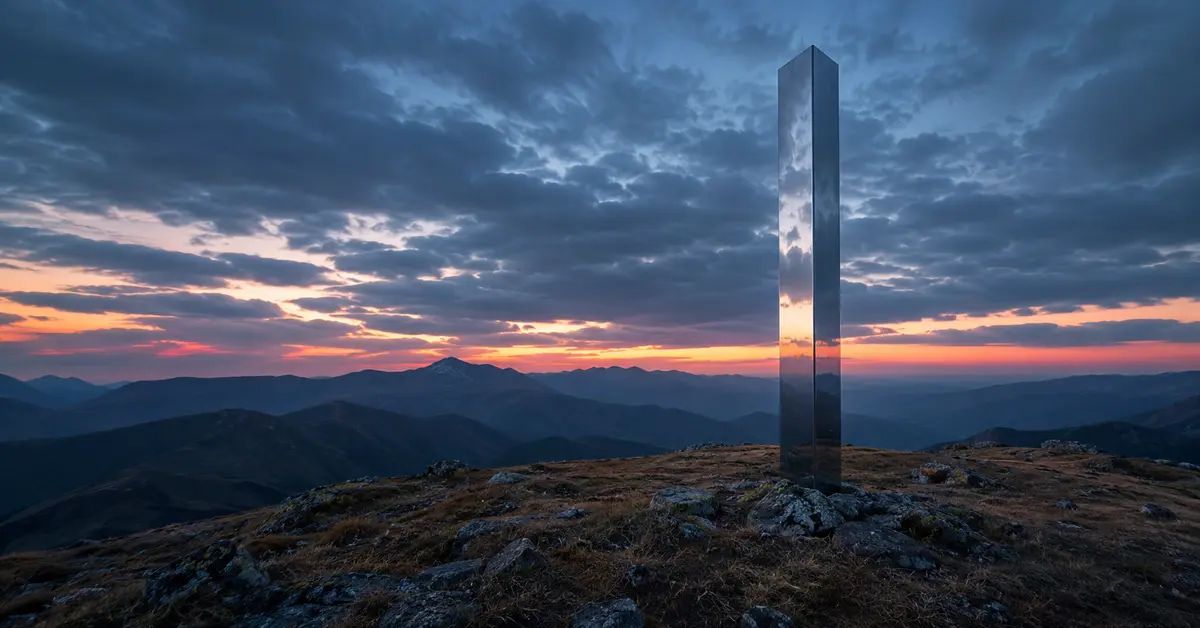
Another Mysterious Monolith Appears in Romania After Utah Monolith Vanished
In late 2020, a strange metal structure appeared in a remote canyon in Utah and instantly became one of the internet’s most irresistible mysteries. It was tall, reflective, sharply geometric, and silent. Then, almost as suddenly as it had been discovered, it vanished. Days later, another mysterious monolith appeared in Romania, giving the story a second life and turning a single desert oddity into a global phenomenon.
Looking back from 2026, the Romanian monolith feels like more than a strange news story. It was part of a moment when the world was anxious, isolated, online, and hungry for mystery. A simple metal object became a screen onto which people projected aliens, art, pranks, marketing, science fiction, and the need to believe that the ordinary world still had secrets.
What happened with the Utah monolith?
Quick answer: The Utah monolith was discovered in November 2020 by officials surveying bighorn sheep from a helicopter. It stood in a remote red-rock canyon, attracted global attention, and disappeared shortly after its location became public.
The Utah structure looked like something dropped from a science fiction film. It was a metallic pillar, widely described as a monolith, standing alone among desert rock formations. Its smooth surface and strange placement made it feel intentional, but no artist, company, or organization immediately took responsibility for it.
Once people online identified the approximate location, visitors began traveling to the site. That quickly created environmental concerns. Remote desert landscapes are fragile, and sudden crowds can damage soil, vegetation, archaeological areas, and wildlife habitats. The object was mysterious, but the human reaction around it became just as important as the object itself.
Then the monolith vanished. Reports later indicated that it had been removed by people who argued that the site was being damaged by visitors. That did not completely end the mystery, because the original creator remained unknown. Instead, the disappearance made the story bigger.
How did the Romanian monolith enter the story?
Shortly after the Utah monolith disappeared, a similar metal structure was reported in Romania near Piatra Neamț. It was found on Bâtca Doamnei Hill, close to an archaeological site, and quickly attracted international media attention.
The Romanian monolith did not look exactly like the Utah one. It was also tall and metallic, but reports described visible differences in finish, texture, and craftsmanship. Some observers saw it as a copy. Others wondered whether it was part of a coordinated global art project. A few preferred the more playful explanation: aliens had simply moved on to Eastern Europe.
The location added to the intrigue. Bâtca Doamnei Hill is associated with ancient history and local significance, so the appearance of a futuristic metal object there created a striking contrast. It looked like a collision between archaeology, science fiction, and internet culture.
Like the Utah monolith, the Romanian structure did not stay long. Its brief appearance was enough to turn the story into a pattern. Once there were two monoliths, people no longer saw the Utah object as a single strange event. They saw the beginning of a mystery chain.
Why did the monoliths capture the world’s imagination?
The monoliths fascinated people because they were simple, visual, unexplained, and easy to share. They appeared at a time when people were spending more time online and were especially drawn to strange stories that felt bigger than everyday life.
The power of the monolith story came from its simplicity. There was no complicated plot to understand. A metal pillar appeared in the desert. It vanished. Another one appeared in Romania. That was enough. The gaps in the story made it irresistible.
People love mysteries that are open-ended. If a story gives too many answers, it becomes ordinary. If it gives just enough evidence to invite speculation, it spreads. The monoliths were perfect for the internet because they could be explained in dozens of ways without any one explanation fully taking control.
They also arrived during a strange emotional period. In 2020, many people were tired of bad news, isolation, and uncertainty. The monoliths offered a different kind of uncertainty – one that felt playful, cinematic, and weirdly hopeful. They gave people something to wonder about.
Possible explanations for the monoliths
The most likely explanations include art installation, copycat prank, viral performance, local promotion, or internet-inspired imitation. There is no credible evidence that the monoliths were extraterrestrial, but the alien theory helped fuel public fascination.
Several explanations have been suggested over the years. None of them fully explains every monolith, because many later structures were probably created by different people for different reasons. Still, the main theories fall into a few categories.
- Art installation: The Utah monolith may have been created as a minimalist artwork, possibly inspired by land art, science fiction, or modern sculpture.
- Copycat structures: After the first story went viral, similar objects appeared in other places, suggesting imitation.
- Publicity stunt: Some later monoliths may have been created to attract media coverage, tourism, or online attention.
- Internet performance: The mystery itself may have been the point, with the public reaction becoming part of the artwork.
- Alien theory: This explanation is entertaining, but there is no reliable evidence to support it.
The most realistic answer is probably mixed. The Utah monolith may have had one origin, the Romanian monolith another, and later objects around the world still others. What connected them was not necessarily one creator, but one viral idea.
Why Romania made the story feel bigger
Romania made the monolith mystery feel global. Once a similar object appeared outside the United States, the story became less about one remote desert and more about a worldwide pattern of unexplained metal structures.
The Romanian monolith changed the emotional shape of the story. A single object in Utah could be dismissed as one anonymous artwork. A second object in Romania made the event feel coordinated, even if it was not. The human brain looks for patterns, and the Romania appearance supplied one.
It also helped internationalize the mystery. People who had followed the Utah story suddenly saw the same visual language appear in Europe. News outlets had an easy headline, social media had a new puzzle, and readers had a reason to ask, “Where will the next one appear?”
That question became part of the phenomenon. Soon, similar structures were reported in other countries and cities. Some were serious, some were obviously playful, and others were promotional. The monolith had become a global meme in physical form.
What the monoliths mean in 2026
In 2026, the monoliths are best understood as a mix of public art, viral culture, mystery marketing, and collective imagination. Their importance is not only in who made them, but in how quickly people turned them into a shared global story.
From today’s perspective, the monolith phenomenon says a lot about modern culture. People are surrounded by cameras, satellites, GPS, drones, and constant documentation. Yet a simple unexplained object can still make the world pause. That is part of the appeal.
The monoliths also show how quickly mystery travels now. In another era, the Utah object may have become a local legend. In 2020, it became global news. The Romanian monolith appeared in the perfect media environment: a world already watching, ready to connect the dots, and eager to turn uncertainty into a story.
By 2026, the mystery has not disappeared completely. Similar reflective structures have continued to pop up from time to time, including later reports in places such as Nevada. The pattern proves that the idea still works. A metal pillar in an unexpected landscape remains enough to trigger curiosity.
The real lesson behind the mystery
The real lesson is that people still crave wonder. Even in a highly connected, heavily documented world, an unexplained object can spark imagination, debate, humor, fear, and creativity across continents.
The monoliths remind us that mystery does not need to be complicated. It can be silent, still, and almost empty. In fact, that emptiness is what makes it powerful. People fill the object with their own meanings.
For some, the monoliths represented alien contact. For others, they were art. For others still, they were a prank, a warning about tourism, or a symbol of how quickly the internet can turn anything into a global event. Each interpretation says as much about the viewer as it does about the object.
That may be why the story lasted. The monoliths were never only about metal. They were about attention, curiosity, and the thrill of not knowing.
Conclusion
The Romanian monolith became famous because it transformed the Utah mystery into a global phenomenon. Whether it was art, imitation, or performance, it proved that people are still deeply attracted to unexplained symbols in unexpected places.
The appearance of another mysterious monolith in Romania after the Utah one vanished was the perfect second act. It expanded the story, intensified speculation, and helped turn a single strange object into a worldwide cultural moment.
In 2026, the best way to understand the monoliths is not to ask only who built them. The better question is why so many people cared. The answer is simple: because mystery still matters. In a world that often feels overexplained, a silent metal pillar on a hill can still make people stop, look, and wonder.


latest video

news via inbox
Nulla turp dis cursus. Integer liberos euismod pretium faucibua