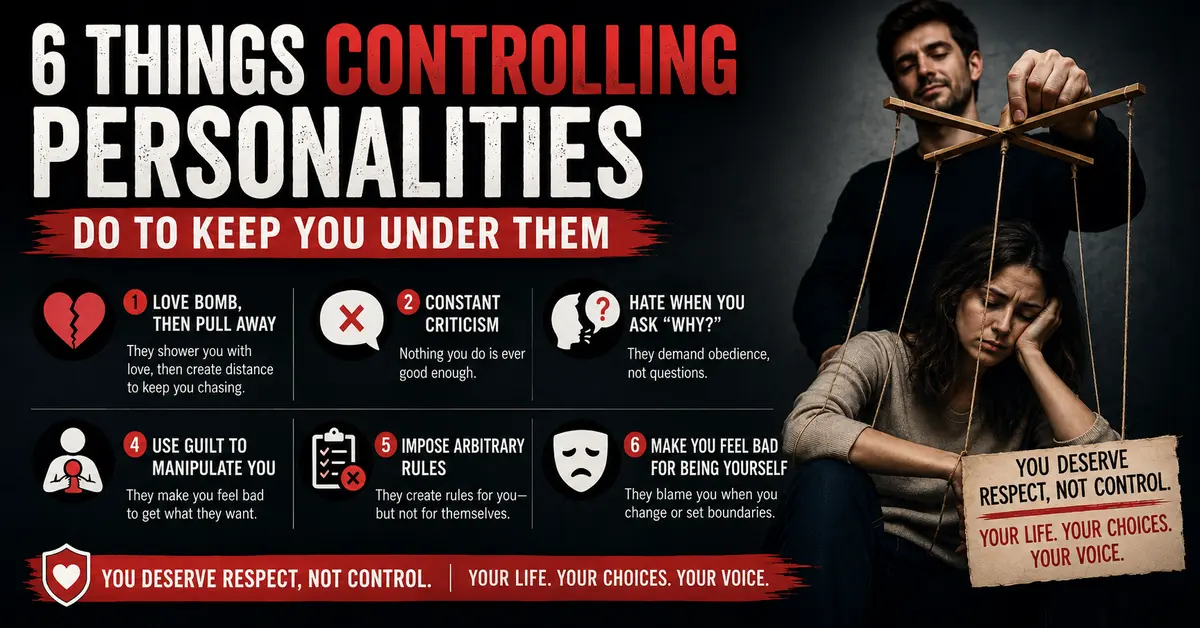
6 Things Controlling Personalities Do to Control You
Controlling personalities do not always look controlling at first.
In the beginning, they may seem loving, protective, attentive, confident, or deeply invested in you. They may say they only want what is best for you. They may act as though their opinions are guidance, their jealousy is love, and their rules are simply “standards.”
But over time, the pattern becomes clearer.
You start questioning your choices. You feel guilty for having boundaries. You become careful about what you say, wear, post, spend, or believe. You may stop doing things you enjoy because it is easier than dealing with their anger, criticism, or disappointment.
That is how controlling behavior works. It often begins subtly, then slowly takes more space in your life.
It is important to be careful with labels. Not every difficult, insecure, opinionated, or demanding person is abusive. However, when someone repeatedly uses manipulation, criticism, guilt, fear, isolation, or emotional pressure to make you behave the way they want, that is a serious warning sign.
Here are six things controlling personalities often do to keep power over others.
1. They Start With Intense Affection, Then Create Distance
One of the most confusing things controlling personalities can do is overwhelm you with attention at the beginning.
They may compliment you constantly, text all day, want commitment quickly, talk about the future too soon, or make you feel like you have finally found someone who truly sees you. This can feel exciting, especially if you have been lonely, hurt, or starved for affection.
But intense affection is not always intimacy.
Sometimes it is love bombing, a pattern where someone uses excessive attention, praise, gifts, or emotional intensity to create fast attachment and gain influence over you.
Once they feel you are emotionally invested, the affection may suddenly change. They may become distant, critical, moody, or hard to please. The warmth you once received freely becomes something you have to earn.
This creates a powerful emotional trap.
You begin chasing the version of them you met at the start. You wonder what you did wrong. You work harder to regain their approval. You may ignore red flags because you remember how good it felt when they were kind.
Healthy love does not require you to earn basic respect.
A person who truly cares about you will not use affection as bait, reward, or punishment.
2. They Criticize Everything You Do
Controlling personalities often use criticism to weaken your confidence.
At first, the criticism may sound small. They may comment on your clothes, your friends, your job, your hobbies, your tone of voice, your spending, your appearance, or the way you handle ordinary tasks.
They may frame it as advice:
- “I am just trying to help you.”
- “You are too sensitive.”
- “You would look better if you listened to me.”
- “Nobody else is honest enough to tell you this.”
- “I only criticize you because I care.”
But constant criticism is not care. It is control.
When someone repeatedly tells you that you are wrong, embarrassing, careless, unattractive, incapable, or difficult, you may slowly begin to believe them. Your self-trust weakens. You become more dependent on their approval. You may start asking for permission instead of making decisions.
That is often the goal.
A controlling person does not always need to physically stop you from doing things. Sometimes they only need to make you doubt yourself enough that you stop yourself.
Respectful partners, friends, or family members can give honest feedback. But honest feedback should not destroy your self-esteem or make you feel permanently inferior.
3. They Hate Being Questioned
Controlling personalities often expect obedience, not discussion.
If you ask why they want something done a certain way, they may become angry, defensive, dismissive, or offended. They may act as though your question is disrespectful simply because it challenges their authority.
You may hear things like:
- “Because I said so.”
- “Why do you always have to argue?”
- “You should just trust me.”
- “Do not question me.”
- “If you loved me, you would not need an explanation.”
Healthy relationships allow questions.
You are allowed to ask why. You are allowed to understand decisions that affect your life. You are allowed to disagree. You are allowed to have your own perspective.
When someone treats normal questions as rebellion, it may be because they do not want mutual respect. They want compliance.
This is especially concerning when questioning them leads to punishment, silent treatment, insults, threats, or emotional withdrawal. Over time, you may stop asking questions just to keep the peace.
But peace that depends on your silence is not real peace.
4. They Use Guilt to Manipulate You
Guilt is one of the most common tools used by controlling personalities.
Instead of asking honestly for what they want, they make you feel selfish, cruel, disloyal, or unloving for having your own needs.
They may say:
- “If you loved me, you would do this.”
- “After everything I have done for you, this is how you treat me?”
- “I guess I just do not matter to you.”
- “You are hurting me by having boundaries.”
- “You should want to make me happy.”
This kind of emotional pressure can be powerful because it uses your empathy against you.
If you are a caring person, you do not want to hurt someone you love. A controlling person may exploit that by making you responsible for their mood, comfort, jealousy, insecurity, or anger.
But love does not require emotional surrender.
You can care about someone without obeying every demand. You can love someone without giving up your boundaries. You can disappoint someone and still be doing the right thing for yourself.
Healthy guilt helps us repair real harm. Manipulative guilt keeps us trapped in roles we never agreed to play.
5. They Create Rules for Your Life
Controlling personalities often create rules that only benefit them.
These rules may be spoken directly, or they may be enforced through anger, judgment, withdrawal, or punishment. Over time, you learn what is “allowed” and what will cause conflict.
The rules might involve:
- Who you can spend time with.
- What you can wear.
- How quickly you must answer messages.
- What you can post online.
- How you should spend money.
- How you should speak to them.
- What opinions you are allowed to express.
- Whether you can have privacy.
The problem is not having shared expectations. Every healthy relationship has agreements. The problem is when one person creates rules without mutual discussion and expects the other person to obey.
A controlling person may claim their rules are about respect, love, tradition, safety, or loyalty. But if the rules only restrict you and never apply equally to them, they are not about respect. They are about power.
Healthy boundaries protect both people.
Controlling rules protect one person’s need to dominate.
6. They Make You Feel Guilty for Becoming Yourself Again
When you begin to recognize controlling behavior, the controlling person may accuse you of changing.
They may say:
- “You are not the person I fell in love with.”
- “You used to be nicer.”
- “You have changed since you started talking to those people.”
- “You think you are better than me now.”
- “You are being selfish.”
Sometimes they are right about one thing: you have changed.
You may have become more aware. More confident. More honest. More willing to say no. More protective of your peace. More connected to the person you were before the relationship made you small.
That kind of change is not betrayal.
It is recovery.
Controlling personalities often feel threatened when you stop responding the way you used to. If guilt no longer works, if criticism no longer controls you, if silence no longer scares you, they may intensify their tactics or try to make you feel ashamed for growing.
But your independence is not a problem.
Your voice is not a problem.
Your boundaries are not a problem.
The problem is anyone who needs you to be smaller so they can feel secure.
Other Warning Signs of Controlling Behavior
Controlling behavior can appear in many forms. It does not always look loud or obvious. Sometimes it is quiet, polished, and difficult to explain to others.
Other warning signs may include:
- Monitoring your phone, messages, location, or social media.
- Isolating you from friends, family, or support systems.
- Making you feel afraid to disagree.
- Blaming you for their anger or reactions.
- Using money to limit your choices.
- Making threats when you try to leave or set boundaries.
- Denying things they said or did until you question your memory.
- Making you feel responsible for keeping the relationship stable.
If a pattern makes you feel smaller, trapped, afraid, confused, or constantly responsible for someone else’s emotions, take it seriously.
You do not need to wait until things become extreme before you call them unhealthy.
What to Do If You Are Dealing With a Controlling Person
If you recognize these patterns, start by trusting your own discomfort.
You do not need to prove every detail before you are allowed to protect yourself. If someone repeatedly ignores your boundaries, dismisses your feelings, punishes your independence, or makes you afraid to be yourself, that is enough reason to step back.
Here are a few practical steps:
- Name the pattern privately. Write down what is happening so you can see it clearly.
- Talk to someone safe. Isolation makes control stronger. Reach out to a trusted friend, family member, counselor, or support service.
- Set one clear boundary. Notice whether they respect it or punish you for having it.
- Do not argue endlessly about your right to have needs. Someone who wants control may turn every explanation into another debate.
- Make a safety plan if you feel threatened. If the person has threatened you, stalked you, controlled your money, or made you afraid to leave, seek professional support before confronting them.
Leaving or changing a controlling dynamic can be emotionally difficult. You may feel guilt, fear, doubt, or attachment to the good moments. That does not mean the pattern is healthy.
It means control often works by mixing affection with harm.
Final Thought
Controlling personalities do not always announce themselves with obvious cruelty.
Sometimes they arrive with charm, affection, advice, concern, or confidence. Then slowly, they begin to criticize, guilt, question, restrict, and reshape your life until you feel less like yourself.
Pay attention to how people respond to your boundaries.
Pay attention to whether love makes you feel free or afraid.
Pay attention to whether someone wants a relationship with you or control over you.
You are allowed to have your own voice, your own choices, your own friends, your own opinions, and your own life.
Anyone who tries to take that from you is not loving you well.

latest video

news via inbox
Nulla turp dis cursus. Integer liberos euismod pretium faucibua