
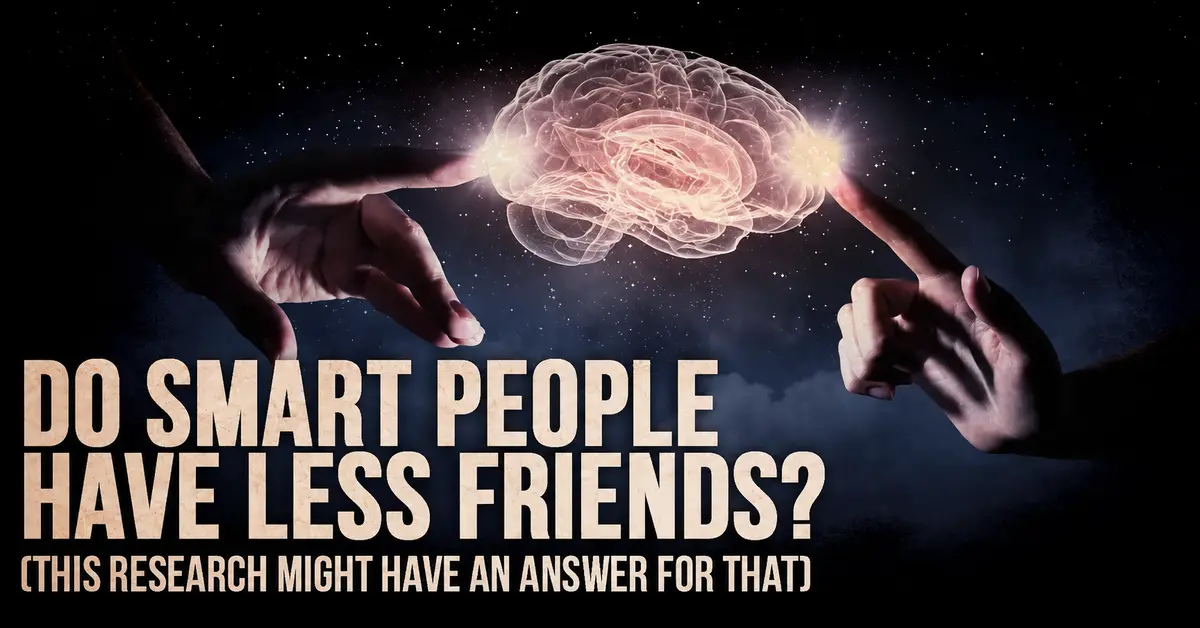
Do Smart People Have Fewer Friends? What Research Says In 2026
Do smart people have fewer friends?
It is a question that often appears in conversations about intelligence, loneliness, introversion, and social life. Some people believe highly intelligent people naturally prefer solitude. Others assume that having fewer friends means someone is antisocial, awkward, or emotionally distant.
The truth is more nuanced.
Some research suggests that highly intelligent people may be less dependent on frequent social interaction for life satisfaction. But that does not mean smart people dislike people, cannot build relationships, or are destined to be lonely.
In many cases, smart people do not necessarily want no friends. They may simply prefer fewer, deeper, more meaningful friendships.
Do Smart People Have Fewer Friends?
Some smart people do have fewer friends, but not always for negative reasons.
A smaller social circle can reflect selectiveness, limited time, different interests, a preference for solitude, or a desire for more meaningful connection. It can also reflect personality. Intelligence and introversion are not the same thing, but some intelligent people may enjoy solitary activities such as reading, researching, writing, building, creating, or thinking deeply.
Having fewer friends does not automatically mean someone is unhappy.
For many people, friendship quality matters more than friendship quantity. A few loyal, honest, emotionally safe friends can be more valuable than a large social circle filled with shallow connections.
That may be especially true for highly reflective people who want conversations that feel real, thoughtful, and mentally stimulating.
What the Research Says About Intelligence and Friendship
A widely discussed 2016 study by evolutionary psychologists Norman P. Li and Satoshi Kanazawa examined the relationship between intelligence, population density, friendship, and life satisfaction.
The study found that, in general, people reported higher life satisfaction when they had more frequent social contact with close friends. That part makes sense. Human beings are social, and strong relationships are consistently linked with well-being.
But the researchers also found an unusual pattern among the most intelligent participants: more frequent socialization with friends was associated with lower life satisfaction for highly intelligent individuals.
This does not mean intelligent people hate their friends. It also does not mean smart people should avoid relationships.
A more careful interpretation is that highly intelligent people may not need the same amount of frequent social interaction to feel satisfied. They may be more focused on long-term goals, independent projects, intellectual work, or inner life. For them, too much socializing may sometimes feel draining, distracting, or less rewarding.
The study is interesting, but it should not be treated as a universal rule. Human behavior is complex, and intelligence is only one part of a person’s personality, social needs, and life satisfaction.
Why Smart People May Prefer Smaller Social Circles
There are several practical reasons smart people may have fewer friends.
First, they may be more selective. If someone values deep conversation, honesty, curiosity, and emotional maturity, they may not feel fulfilled by casual or superficial relationships.
Second, they may enjoy solitude. Many intelligent people use time alone to think, study, solve problems, create, read, write, or recharge. Solitude can be productive and peaceful rather than lonely.
Third, they may have unusual interests. Someone deeply interested in philosophy, science, strategy, art, technology, psychology, or abstract ideas may not easily find people who share the same intensity.
Fourth, they may protect their mental energy. Socializing can be enjoyable, but it also requires attention, emotional effort, and time. A highly focused person may choose fewer social commitments because they are trying to preserve energy for meaningful work or personal goals.
None of these reasons mean smart people are better than others. They simply suggest that different people need different kinds of social connection.
Smart People Are Not Automatically Antisocial
It is important to avoid a common myth: having fewer friends does not mean someone is antisocial.
Antisocial behavior usually refers to behavior that disregards or harms others. Preferring solitude, enjoying quiet activities, or maintaining a small circle of friends is not the same thing.
A person can be socially selective and still be kind.
A person can enjoy time alone and still love deeply.
A person can dislike small talk and still value meaningful connection.
Many intelligent people are socially capable, emotionally warm, and deeply loyal. They may simply be less interested in constant social activity, large groups, or relationships that feel forced.
The real issue is not the number of friends someone has. The real issue is whether their relationships feel healthy, mutual, and meaningful.
Intelligence Comes in Different Forms
Another reason this topic is complicated is that intelligence is not only one thing.
Psychologist Robert Sternberg is known for a broader view of intelligence that includes analytical intelligence, creative intelligence, and practical intelligence. Analytical intelligence involves reasoning and problem-solving. Creative intelligence involves generating new ideas and adapting to novelty. Practical intelligence involves applying knowledge effectively in real-life situations.
This matters because a high IQ does not automatically guarantee social wisdom.
Someone can be brilliant in mathematics, science, writing, or strategy and still struggle with communication, emotional awareness, conflict, or reading social cues. Another person may not score exceptionally high on traditional intelligence tests but may have excellent practical judgment, empathy, and relationship skills.
Friendship does not run only on analytical intelligence.
It also requires listening, patience, vulnerability, humor, trust, emotional regulation, and reciprocity.
So when we ask, “Do smart people have fewer friends?” we should also ask, “What kind of intelligence are we talking about?”
Why Smart People May Struggle to Connect
Some intelligent people struggle socially because they experience the world differently.
They may think more deeply about things others treat casually. They may notice patterns, contradictions, or details that other people miss. They may become bored by repetitive small talk or frustrated by conversations that feel shallow.
This can make connection harder, especially if they feel misunderstood.
For example, a highly analytical person may want to discuss ideas, systems, books, ethics, technology, psychology, or future possibilities. If the people around them prefer gossip, surface-level updates, or social performance, the intelligent person may slowly withdraw.
That withdrawal is not always arrogance. Sometimes it is exhaustion.
However, intelligent people also need to be careful. Wanting deeper connection should not become contempt for ordinary conversation. Small talk can be a doorway to trust. Casual interactions can become meaningful over time. Not every connection begins with depth.
Sometimes the challenge is learning how to meet people where they are without pretending to be someone else.
Fewer Friends Can Mean Deeper Friendships
There is nothing wrong with having a small circle.
Some people thrive with many friends, regular gatherings, and a busy social calendar. Others feel happiest with two or three close people they trust completely.
Smart people may often prefer the second option.
They may value friends who challenge their thinking, respect their independence, understand their need for quiet, and allow conversations to move beyond routine subjects. They may prefer relationships where silence is comfortable and honesty is possible.
A meaningful friendship does not need constant contact to be strong.
Some friendships survive because both people understand each other’s pace. They may not speak every day, but when they do, the connection still feels real. They may have separate lives, but the bond remains steady.
For a person who values depth, that can matter more than popularity.
When Having Fewer Friends Becomes a Problem
Having fewer friends is not automatically unhealthy.
But isolation can become a problem when it is driven by fear, bitterness, avoidance, shame, or the belief that nobody is worth trusting.
There is a difference between choosing solitude and feeling trapped in loneliness.
A small social circle may be healthy if:
- You feel peaceful, not abandoned.
- You have at least a few people you can trust.
- You can ask for help when you need it.
- You are not avoiding connection because of fear.
- Your alone time helps you recharge rather than disappear.
A small social circle may be unhealthy if:
- You feel chronically lonely.
- You want connection but do not know how to build it.
- You push people away before they can know you.
- You assume everyone will disappoint you.
- You use intelligence as a shield against vulnerability.
Smart people still need connection. They may not need constant socializing, but they do need relationships that support emotional health, belonging, and trust.
Why Quality Matters More Than Quantity
The number of friends you have says less about your life than the quality of those friendships.
A person with many acquaintances can still feel lonely. A person with a small circle can feel deeply loved. What matters is whether the relationships are mutual, honest, respectful, and emotionally nourishing.
Good friends help you feel seen. They tell you the truth. They celebrate your growth. They respect your boundaries. They do not require you to perform a version of yourself that feels false.
For smart people, meaningful friendships may be especially important because intellectual connection alone is not enough. Everyone needs people who care about more than what they can think, achieve, or explain.
The best friendships make room for the whole person.
The mind, the heart, the humor, the silence, the ambition, the flaws, and the parts that are still learning how to be understood.
How Smart People Can Build Better Friendships
If you are intelligent but often feel disconnected from others, the answer is not necessarily to force yourself into a large social circle.
The better goal is to build friendships that match your values and emotional needs.
Here are a few ways to do that:
- Look for shared interests. Join groups, classes, communities, or events connected to topics you genuinely care about.
- Practice patience with small talk. Not every meaningful friendship begins with a deep conversation.
- Be curious about people. Intelligence becomes more socially useful when it is paired with empathy.
- Do not confuse selectiveness with superiority. Wanting depth is healthy. Looking down on others is not.
- Make room for emotional honesty. Friendship is not only about exchanging ideas. It is also about trust.
- Protect your solitude without disappearing. Let people know you value them, even if you need space.
Smart people do not need dozens of friends to be happy. But they do need relationships where they can be real.
Final Thought
So, do smart people have fewer friends?
Sometimes, yes.
But fewer friends does not mean less love, less happiness, or less social ability. It may mean that intelligent people are more selective, more independent, more focused, or more drawn to deeper relationships than frequent socializing.
The important question is not how many friends you have.
The important question is whether the people in your life understand you, respect you, challenge you, and make you feel more like yourself.
A large social circle can be wonderful.
But for some people, a small circle of true friends is more than enough.


latest video

news via inbox
Nulla turp dis cursus. Integer liberos euismod pretium faucibua