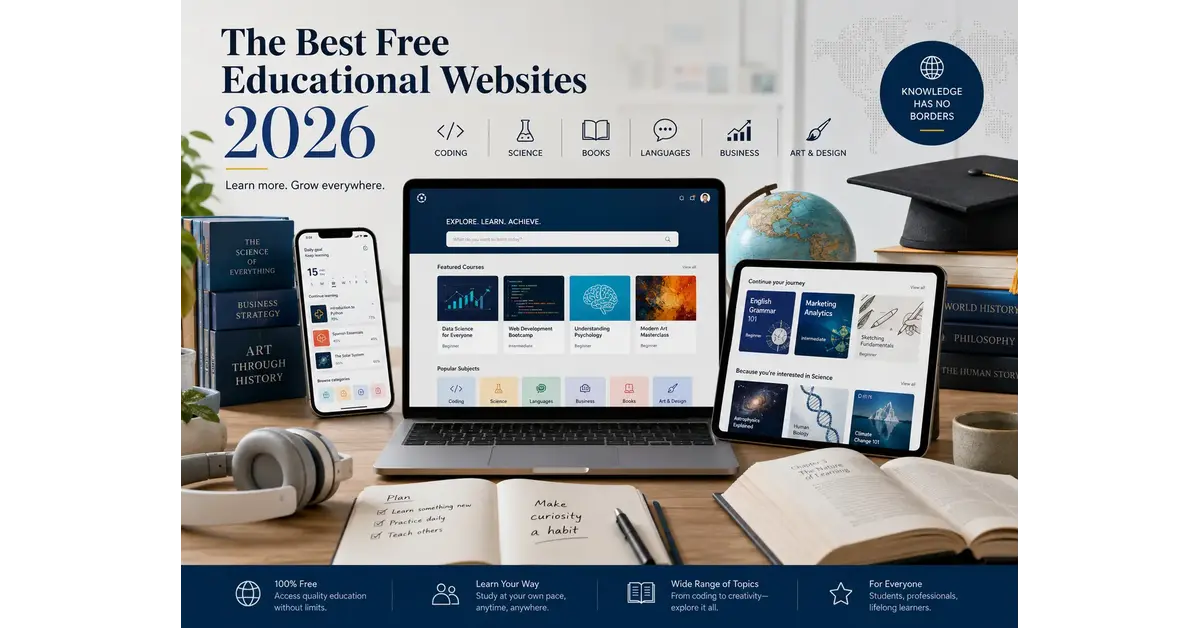
This updated guide to Free Educational Websites in 2026 is built for people who want real learning, not random links. Instead of listing outdated bookmarks, it expands and modernizes the older 2014-style “40 free educational websites” format into a curated 2026 master list for an international audience. Some older platforms were useful at the time; however, several no longer belong in a current article.
For example, iTunes U is no longer a reliable 2026 recommendation because Apple discontinued it at the end of 2021, and Open2Study closed in 2019. Therefore, this version focuses on resources that still offer meaningful free access, strong educational value, and practical use today.
A quick note before the list: “free” can mean different things. Some websites offer free course materials, others offer free full courses, and some charge only for certificates. In addition, several platforms use a freemium model. edX, for example, separates free audit access from paid verified certificates, while Saylor Academy offers free course completion certificates for completed courses.
What makes a free educational website worth using?
The best free educational websites in 2026 are useful because they combine access, structure, and clear learning outcomes. In other words, they do more than host videos or PDFs. A strong platform helps you understand what to study next, practice the skill, and apply what you learn through exercises, projects, quizzes, reading, or real-world examples.
For informational searches, this guide is organized by learning goal. As a result, you can quickly compare free online courses, open textbooks, coding practice sites, language learning tools, STEM resources, research libraries, and professional skill platforms without jumping between dozens of separate lists.
Quick picks by goal
Quick answer: The best free learning site depends on what you want to do. For university-style learning, start with MIT OpenCourseWare or OpenLearn. For coding, choose freeCodeCamp or CS50. Meanwhile, OpenStax works well for textbooks, LibriVox for audiobooks, Duolingo for language practice, and Khan Academy for school-level foundations.
- Best for university-level courses: MIT OpenCourseWare
- Best for structured coding: freeCodeCamp
- Best for computer science fundamentals: CS50x
- Best for free textbooks: OpenStax
- Best for classic ebooks: Project Gutenberg
- Best for free audiobooks: LibriVox
- Best for math and school foundations: Khan Academy
- Best for interactive science: PhET
- Best for language practice: Duolingo
- Best for finding courses across platforms: Class Central
University-level courses and open learning
Quick answer: These platforms are best for learners who want serious academic content without enrolling in a degree. They are useful for self-study, professional development, intellectual curiosity, and building a structured learning routine around real university materials. In particular, they are a good fit for people searching for free university courses online.
MIT OpenCourseWare provides free, openly licensed materials from more than 2,500 MIT courses, while OpenLearn offers hundreds of free courses from The Open University. Open Yale Courses gives free access to selected Yale lectures, and Harvard keeps a catalog of free online courses through its continuing education platform.
- MIT OpenCourseWare – One of the strongest free educational websites for university-level materials in engineering, science, economics, humanities, and more.
- OpenLearn – Free courses from The Open University, useful for beginners and adult learners who want structured study.
- Open Yale Courses – Selected Yale courses with lecture videos, audio, and transcripts. Best for humanities, social sciences, literature, history, psychology, and political philosophy.
- Harvard Free Online Courses – Harvard’s catalog of free courses, including technology, humanities, science, and culture.
- edX – University-backed courses from global institutions. Many courses can be audited for free, but graded assignments and certificates are often paid.
- Coursera Free Courses – A large catalog of courses from universities and companies. Always check whether the full course, certificate, or only the preview is free.
- FutureLearn – Free online courses from universities and organizations, especially strong in healthcare, education, psychology, business, and social topics.
- Saylor Academy – Self-paced, tuition-free courses in business, computer science, humanities, math, and professional development.
Open course platforms for independent learners
Next, these options help learners compare courses, study across institutions, or explore global academic material beyond a single university.
- Carnegie Mellon Open Learning Initiative – Research-based courses for independent learners, especially useful for statistics, biology, psychology, computing, and language learning.
- NPTEL – Courses from IITs and IISc in India, especially strong for engineering, computer science, science, and management. Courses are free to enroll and learn from.
- SWAYAM – A large Government of India online learning platform with courses across school, college, and professional subjects.
- Class Central – Not a course provider, but one of the best search engines for finding MOOCs and free online courses from many platforms.
- Open Culture Free Courses – A long-running directory of free university courses, lectures, audiobooks, ebooks, language lessons, and cultural resources.
- Academic Earth – A directory of free online college courses and lectures, useful for browsing by subject.
- World Science U – Science learning from physicist Brian Greene and collaborators, especially good for visual explanations of physics and cosmology.
Coding, software development, and computer science
Quick answer: For coding, prioritize platforms with exercises, projects, and documentation instead of passive video watching. In practice, freeCodeCamp, The Odin Project, CS50, MDN, Exercism, GitHub Skills, and Kaggle Learn are especially useful because they encourage building, practicing, and solving problems.
freeCodeCamp offers a free curriculum with project-based certifications, CS50x 2026 provides a free certificate for learners who meet its coursework requirements, and Kaggle Learn offers no-cost practical data courses with certificates.
- freeCodeCamp – Best for structured coding practice, web development, Python, databases, JavaScript, APIs, and project-based certificates.
- CS50x – Harvard’s famous introduction to computer science. Best for learning computational thinking, C, Python, SQL, algorithms, and problem solving.
- The Odin Project – A free, open-source path for full-stack web development with projects and community learning.
- MDN Learn Web Development – One of the best free resources for learning modern HTML, CSS, JavaScript, accessibility, and web standards.
- W3Schools – Beginner-friendly tutorials and references for HTML, CSS, JavaScript, SQL, Python, and more.
- Exercism – Free programming exercises and mentoring across many languages. Excellent after you learn the basics and need practice.
- GitHub Skills – Interactive courses for learning GitHub, Markdown, pull requests, GitHub Actions, and collaboration.
- Kaggle Learn – Short, practical courses in Python, pandas, machine learning, SQL, data visualization, and AI workflows.
- Microsoft Learn – Official learning paths for Azure, Microsoft 365, Power Platform, security, developer tools, and AI.
- Google Skillshop – Free training for Google Ads, Analytics, Campaign Manager, Google Marketing Platform, and related tools.
Technical documentation, cloud skills, and coding practice
After you have a foundation, these resources help you practice with real tools, build job-ready knowledge, and explore more specialized technical skills.
- Udacity Free Courses – Free tech courses in Python, SQL, AI, data analysis, and product design. Nanodegrees are paid, but some individual courses are free.
- Cisco Networking Academy – Useful for networking, cybersecurity, Python, Linux, and IT foundations.
- IBM SkillsBuild – Free technology and career learning in AI, cybersecurity, data, cloud, workplace skills, and job readiness.
- AWS Skill Builder – Free and paid cloud learning resources. Good for AWS basics, cloud literacy, and exam preparation paths.
- Oracle Dev Gym – Quizzes and workouts for SQL, PL/SQL, database concepts, and Oracle technologies.
- SQLBolt – Simple interactive SQL lessons for beginners.
- Mode SQL Tutorial – Practical SQL lessons with business-style data analysis examples.
- RegexOne – A focused interactive site for learning regular expressions.
- OverTheWire – Security-focused command-line and cybersecurity games. Best for learners who want hands-on Linux and security practice.
- Project Euler – Math and programming problems for people who enjoy logic, algorithms, and puzzle-style learning.
AI, machine learning, and data science
Quick answer: For AI and data science, use resources that teach concepts and hands-on implementation. For quick practice, Kaggle Learn is a good starting point. After that, fast.ai is excellent for applied deep learning, Hugging Face Learn is strong for modern AI tooling, and Google or Microsoft resources help with workplace AI skills.
Google’s AI training hub offers practical AI courses and tools, Hugging Face Learn covers LLMs and the open-source AI ecosystem, and fast.ai provides a free applied deep learning course for people with some coding experience.
- Google AI Training – Practical AI learning from Google, useful for productivity, workplace AI, and foundational AI concepts.
- Hugging Face Learn – Courses on LLMs, agents, transformers, computer vision, diffusion models, audio, reinforcement learning, and open-source AI tools.
- fast.ai – A practical deep learning course that focuses on building useful models, not just theory.
- Kaggle Competitions – Practice data science with real datasets and community notebooks.
- Google Machine Learning Crash Course – A classic beginner-friendly introduction to machine learning concepts.
- TensorFlow Tutorials – Official tutorials for TensorFlow, deep learning, computer vision, text, and structured data.
- PyTorch Tutorials – Official PyTorch learning materials for deep learning and model building.
- scikit-learn User Guide – Best for classical machine learning in Python.
- Google Colab – A free browser-based notebook environment for Python, data analysis, and machine learning experiments.
- Papers with Code – Research papers connected to code, datasets, benchmarks, and implementations.
Math, science, engineering, and STEM
Quick answer: Use Khan Academy for foundations, PhET for interactive simulations, OpenStax for textbooks, NASA for space and STEM resources, and HHMI BioInteractive for biology. Overall, these resources are useful for students, teachers, homeschoolers, and adult learners rebuilding fundamentals.
Khan Academy is a nonprofit that provides free learning in math, science, computing, economics, history, and more. PhET offers free interactive science and math simulations from the University of Colorado Boulder, and NASA maintains STEM learning resources for educators, students, parents, and caregivers.
- Khan Academy – One of the best all-around free educational websites for math, science, economics, computing, history, and test prep.
- PhET Interactive Simulations – Interactive simulations for physics, chemistry, math, biology, and earth science.
- NASA Learning Resources – Space, science, engineering, games, activities, e-books, and educator materials.
- HHMI BioInteractive – High-quality biology and life science resources, including videos, classroom activities, data points, and virtual labs.
- CK-12 – Free digital textbooks, practice, simulations, and adaptive learning for K-12 math and science.
- MathWorld – A deep mathematical encyclopedia from Wolfram, best for reference and advanced topics.
- Wolfram Demonstrations Project – Interactive demonstrations for math, science, engineering, economics, and computation.
- BetterExplained – Clear conceptual explanations for math topics that often feel abstract.
- 3Blue1Brown – Visual math explanations, especially strong for calculus, linear algebra, neural networks, and probability.
STEM videos, citizen science, and classroom resources
In addition to textbooks and simulations, these websites support visual learning, research participation, and classroom activities.
- Crash Course – Fast, engaging video courses in history, science, economics, literature, media literacy, and more.
- TED-Ed – Short animated lessons and educational videos across science, history, language, philosophy, and culture.
- Zooniverse – Citizen science projects where learners can contribute to real research.
- National Geographic Education – Geography, environment, exploration, maps, activities, and classroom resources.
- NOAA Education – Ocean, atmosphere, climate, weather, and environmental science resources.
- Exploratorium Learning Toolbox – Science activities and teaching resources from the Exploratorium museum.
Free books, textbooks, libraries, and research
Quick answer: Free learning is not only about courses. To study deeply, readers should combine open textbooks, classic literature, digital libraries, research archives, and public domain books. For that reason, OpenStax, Project Gutenberg, Internet Archive, Open Library, arXiv, PubMed Central, and DOAJ are essential.
OpenStax is a nonprofit at Rice University that publishes open educational resources, Project Gutenberg offers over 75,000 free ebooks, LibriVox provides free public domain audiobooks, and Internet Archive offers free access to texts, media, and archived web pages.
- OpenStax – Free textbooks for college, high school, AP, and foundational subjects.
- Project Gutenberg – Public domain ebooks, especially classic literature, philosophy, history, and older reference works.
- Internet Archive – A massive digital library for books, audio, video, software, and archived websites. Note that modern copyrighted book access can be affected by legal restrictions, so check each item’s lending status.
- Open Library – A project of the Internet Archive focused on book records and digital lending where available.
- LibriVox – Free audiobooks of public domain works, read by volunteers.
- Standard Ebooks – Carefully formatted public domain ebooks with cleaner typography and metadata than many raw scans.
- Wikisource – A free library of source texts, documents, historical works, speeches, and public domain material.
Open research, journals, and academic search tools
Finally, these resources are useful when you need research papers, academic books, source texts, or journal articles rather than standard courses.
- Wikibooks – Free textbooks and manuals created collaboratively.
- Directory of Open Access Books – Academic open access books from scholarly publishers.
- OAPEN Library – Open access academic books, especially in humanities and social sciences.
- arXiv – Preprints in physics, mathematics, computer science, quantitative biology, statistics, electrical engineering, economics, and related fields.
- PubMed Central – Free full-text archive of biomedical and life sciences journal literature.
- DOAJ – Directory of open access journals across many academic fields.
- CORE – Search engine for open access research papers.
- Google Scholar – Not everything is free, but it is useful for finding papers, citations, authors, and free PDF versions when available.
Languages, communication, and writing
Quick answer: For languages, combine daily practice, listening, reading, pronunciation, and real media. Duolingo is good for habit building, while TV5MONDE is strong for French listening. Similarly, Deutsche Welle is strong for German, NHK is useful for Japanese, and Purdue OWL is excellent for academic writing.
Duolingo says its courses are free and include more than 40 languages, TV5MONDE offers thousands of free French exercises, and NHK’s Easy Japanese program provides beginner Japanese lessons in multiple languages.
- Duolingo – Good for daily language habit building, vocabulary, grammar drills, and beginner practice.
- Deutsche Welle Learn German – Free German learning resources from Germany’s international broadcaster.
- TV5MONDE Learn French – Free French exercises based on videos, news, culture, and real-world listening.
- NHK Easy Japanese – Free beginner Japanese lessons with audio, dialogues, and cultural notes.
- FSI Language Courses – Older public domain language courses from the Foreign Service Institute. Best for serious, audio-heavy study.
- Forvo – Pronunciation examples recorded by native speakers.
- YouGlish – Learn pronunciation and usage from real video examples.
- Purdue Online Writing Lab – One of the best free resources for academic writing, grammar, citation formats, resumes, and professional writing.
- Hemingway Editor – Free browser-based writing feedback for clarity and sentence complexity.
- ReadTheory – Reading comprehension practice, useful for English learners and students.
Business, marketing, entrepreneurship, and career skills
Quick answer: For professional skills, focus on platforms that teach practical tasks and produce portfolio-ready outcomes. In this category, HubSpot Academy, Google Digital Garage, HP LIFE, Y Combinator Startup School, Microsoft Learn, and IBM SkillsBuild are strong because they connect learning with real workplace skills.
HubSpot Academy offers free online training and certifications, HP LIFE provides free business and digital skills courses with certificates of completion, and Y Combinator Startup School is a free online course for founders.
- HubSpot Academy – Free courses and certifications in marketing, sales, customer service, content, email, social media, and CRM.
- Google Digital Garage – Free digital skills training in marketing, online business, productivity, coding basics, and career development.
- HP LIFE – Free business, digital, and future-of-work skills courses with certificates of completion.
- Y Combinator Startup School – Free startup education for founders, including accountability, startup advice, and co-founder resources.
- SCORE – Free and low-cost business workshops, mentoring, and entrepreneurship resources.
- U.S. Small Business Administration Learning Platform – Free business learning modules for planning, launching, managing, and growing a business.
- Meta Blueprint – Training for Meta advertising, business pages, Instagram, and digital marketing.
- Semrush Academy – Free SEO, content marketing, PPC, and digital marketing courses.
- Ahrefs Academy – Free SEO and marketing courses, especially useful for search, content, and link building.
- Moz SEO Learning Center – Beginner-friendly SEO guides and learning resources.
Arts, design, music, history, and culture
Quick answer: Free educational websites are not limited to academic or technical learning. Instead, they also support creativity, culture, music, and design. Google Arts & Culture, Smithsonian Learning Lab, The Met, Canva Design School, JustinGuitar, MusicTheory.net, and Teoria are excellent for visual learning, creative practice, music, culture, and art history.
Google Arts & Culture features content from more than 2,000 museums and archives, Smithsonian Learning Lab connects learners to Smithsonian objects and resources, and The Met’s Heilbrunn Timeline includes more than 1,000 essays and 300 chronologies.
- Google Arts & Culture – Virtual museum collections, exhibitions, art history, cultural stories, and high-resolution imagery.
- Smithsonian Learning Lab – Free educational collections using Smithsonian museum objects, images, texts, and activities.
- The Met Heilbrunn Timeline of Art History – Essays, chronologies, artworks, and art history references from The Metropolitan Museum of Art.
- Canva Design School – Free design tutorials and courses, especially useful for beginners, teachers, students, creators, and small business owners.
- JustinGuitar – Structured free guitar lessons, practice plans, songs, theory, and beginner-friendly guidance.
- MusicTheory.net – Free lessons and exercises for notes, intervals, chords, scales, rhythm, and ear training.
- Teoria – Music theory tutorials and ear training exercises.
- GCFGlobal – Free tutorials for technology, work, reading, math, everyday life, Microsoft Office, Google tools, and career basics.
- The Kennedy Center Education – Arts education resources, performances, activities, and teaching materials.
General knowledge and learning directories
Quick answer: These websites help you explore, verify, and organize knowledge. Wikipedia is good for first-pass orientation, Wikiversity and Wikibooks support collaborative learning, Class Central helps you find courses, and Open Culture helps you discover free books, lectures, films, courses, and audio.
Wikipedia is a free online encyclopedia created and edited by volunteers, and Wikiversity is a Wikimedia project for free learning resources. These are useful starting points, but important claims should still be checked against primary sources.
- Wikipedia – Best used as a starting point for orientation, definitions, timelines, and references.
- Wikiversity – Free learning resources and collaborative educational projects.
- Wikibooks – Collaborative free textbooks and manuals.
- Wiktionary – Free dictionary, etymology, translations, pronunciation, and language reference.
- Open Culture – Curated free courses, audiobooks, ebooks, films, textbooks, and language resources.
- Class Central – Course search engine for MOOCs, certificates, universities, and online learning providers.
- MOOC List – Directory of free online courses and MOOCs from multiple providers.
How to choose from this list
Quick answer: Do not bookmark 50 sites and call it progress. Choose one main platform, one practice resource, and one reference source. Then set a weekly output goal, such as finishing one module, solving 20 exercises, writing one summary, or building one small project.
Use this simple filter:
- Goal: Are you learning for school, career, curiosity, or a specific project?
- Format: Do you learn better from video, text, exercises, books, audiobooks, or projects?
- Depth: Do you need beginner material, university-level content, or professional practice?
- Proof: Do you need a certificate, a portfolio project, a test score, or personal knowledge?
- Time: Can you realistically study 20 minutes a day, 3 hours per week, or more?
For serious skill building, the best setup is usually:
- One structured course
- One practice platform
- One reference source
- One project or output
- One fixed weekly review session
Best learning stacks by goal
Quick answer: A learning stack is a small group of resources that work together. The point is to avoid jumping randomly between websites. A good stack gives you structure, practice, reference, and output.
Learn web development
- Course: The Odin Project
- Practice: freeCodeCamp
- Reference: MDN Web Docs
- Portfolio: Build 3 small projects and publish them on GitHub
Learn data science
- Course: Kaggle Learn
- Practice: Kaggle Competitions
- Reference: scikit-learn User Guide
- Output: One notebook that explains a dataset clearly
Learn AI
- Course: Google AI Training
- Applied learning: fast.ai
- Modern tools: Hugging Face Learn
- Output: A small AI demo, notebook, or workflow
Learn math foundations
- Lessons: Khan Academy
- Visual explanations: 3Blue1Brown
- Practice: PhET
- Reference: MathWorld
Read more books for free
- Classics: Project Gutenberg
- Better formatting: Standard Ebooks
- Audiobooks: LibriVox
- Research books: DOAB
Learn digital marketing
- Foundation: Google Digital Garage
- SEO: Moz SEO Learning Center
- Content and inbound: HubSpot Academy
- Tools: Semrush Academy
Common mistakes to avoid
Quick answer: The biggest mistake is confusing collecting resources with learning. A list like this is only useful if it leads to action. Pick fewer websites, finish more lessons, and create visible proof of what you learned.
- Avoid starting five courses on the same topic.
- Build skills before chasing certificates.
- Use videos as one tool, not your entire learning system.
- Complete exercises, because practice is where learning becomes usable.
- Check whether a “free” course also includes a free certificate.
- Skip outdated platforms just because they appeared in old lists.
- Review licensing if you reuse materials publicly.
- Turn reading into notes, summaries, code, designs, or projects.
Frequently asked questions about Free Educational Websites in 2026
What are the best free educational websites in 2026?
The best options depend on your goal. For university-style learning, MIT OpenCourseWare, OpenLearn, edX, Coursera free courses, and Saylor Academy are strong starting points. For coding, freeCodeCamp, CS50x, The Odin Project, MDN, and Exercism are especially practical. Meanwhile, Khan Academy, OpenStax, Project Gutenberg, LibriVox, Duolingo, and Class Central cover school subjects, textbooks, books, audiobooks, languages, and course discovery.
Are free online courses really free?
Many free online courses let you access lessons, readings, videos, and exercises without paying. However, certificates, graded assignments, mentoring, or advanced features may cost money. Therefore, always check whether the course is free to audit, free to complete, or free only as a preview.
Which free educational websites offer certificates?
Some platforms offer free certificates, while others charge for verified certificates. Saylor Academy, freeCodeCamp, CS50x, Kaggle Learn, HP LIFE, and several professional training platforms can be useful starting points. Even so, certificate rules change, so check the current certificate policy before you begin.
What is the best way to choose a free learning website?
Start with your goal, then choose one structured course, one practice resource, and one reference source. For example, a web development learner might use The Odin Project for structure, freeCodeCamp for practice, MDN for reference, and GitHub for a portfolio. This approach keeps learning focused and prevents bookmark overload.
Final takeaway
Quick answer: The internet already contains enough Free Educational Websites in 2026 to build serious knowledge in almost any field. Access is no longer the main problem. Instead, the real challenge is choosing high-quality resources, staying consistent, practicing actively, and turning learning into output.
Start with one category from this list, then choose one site. After that, set a 30-day goal and measure progress by what you can solve, explain, build, write, design, or teach.
Free learning works best when it becomes a habit, not a bookmark folder.