
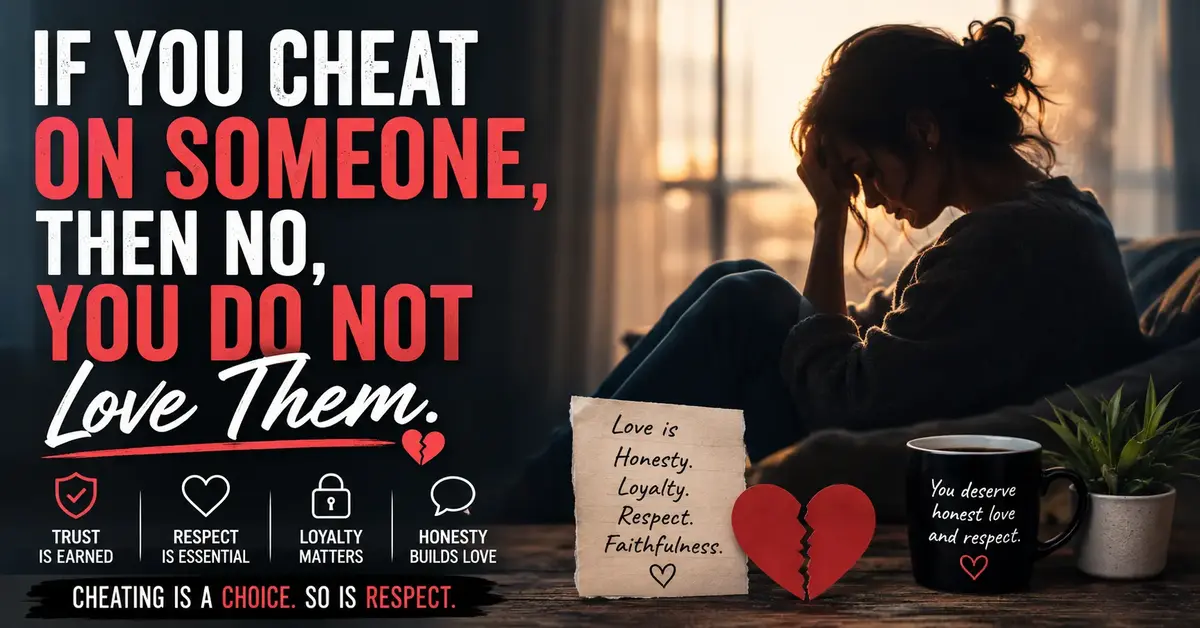
If You Cheat on Someone, Do You Really Love Them?
If you cheat on someone you do not love them in the way they deserve to be loved.
That may sound harsh, but cheating is harsh. It is not just a mistake, a weak moment, or something that “just happened.” Cheating is a choice that breaks trust, damages emotional safety, and forces the betrayed person to carry pain they never agreed to carry.
Real love is not only about saying the words “I love you.” Love is also shown through honesty, loyalty, respect, self-control, communication, and the willingness to protect the person you claim to care about.
When you cheat, you are not protecting them.
You are putting your desire, ego, secrecy, or temporary satisfaction above their emotional well-being. You are making a decision that can leave them questioning their worth, their memories, their judgment, and their ability to trust again.
So no, if you cheat on someone you do not love them with the kind of love they deserve.
Cheating Is a Betrayal of Trust
Trust is one of the foundations of a healthy relationship.
Without trust, love becomes unstable. Every conversation can feel uncertain. Every silence can feel suspicious. Every late reply can become a trigger. The person who was betrayed may begin to question what was real, what was hidden, and how long they were being lied to.
That is why cheating hurts so deeply. It is not only about physical contact or emotional intimacy with someone else. It is about deception.
Cheating often involves secrecy, deleted messages, half-truths, emotional distance, excuses, and broken agreements. It tells your partner that the relationship they thought they were living in was not the full truth.
That kind of betrayal can shake a person’s sense of safety.
Love cannot grow in an environment where one person is being honest and the other is living a hidden life.
If You Cheat, You Break More Than a Rule
Some people try to reduce cheating to a technical violation: “It was only one night,” “It did not mean anything,” or “It was just physical.”
But cheating is rarely small to the person who was betrayed.
It can break their confidence. It can make them compare themselves to someone else. It can make them replay conversations, memories, and warning signs. It can make them wonder if they were foolish for trusting you.
When someone is cheated on, they may ask painful questions:
- Was I not enough?
- What did I miss?
- How long was I being lied to?
- Did they ever really love me?
- Can I ever trust anyone again?
The betrayed person often suffers twice: first from the cheating itself, and then from the emotional confusion it leaves behind.
That is why cheating is not just about sex, flirting, messages, or secrecy. It is about the damage done to someone’s ability to feel safe with you.
Love Without Respect Is Not Enough
Someone may claim they cheated but still loved their partner.
Maybe they felt attached. Maybe they cared. Maybe they did not want the relationship to end. Maybe they loved the comfort, history, attention, or stability their partner provided.
But love without respect is not enough.
If you love someone but still choose to betray them, lie to them, expose them to emotional pain, and risk the relationship without their knowledge, then your love is not mature enough to protect them.
Respect means considering how your actions will affect the person you claim to love.
Respect means honoring the agreements you made.
Respect means ending a relationship before violating it.
Respect means telling the truth instead of building comfort on lies.
When cheating happens, respect has already been broken. And once respect is broken, love becomes very difficult to trust.
Cheating Is Not the Betrayed Person’s Fault
One of the cruelest parts of being cheated on is the self-blame that often follows.
The betrayed person may wonder what they did wrong. They may think they were not attractive enough, exciting enough, available enough, successful enough, affectionate enough, or easy enough to love.
But cheating is not caused by the betrayed person’s imperfections.
Every relationship has problems. People feel lonely, frustrated, unseen, bored, angry, rejected, or disconnected at times. Those feelings may signal that a relationship needs serious attention. But they do not force someone to cheat.
A person who is unhappy has options.
- They can communicate honestly.
- They can ask for counseling.
- They can set boundaries.
- They can take responsibility for their needs.
- They can leave the relationship before starting another one.
Cheating is not the only option. It is the dishonest one.
If someone cheated on you, their choice belongs to them. Their betrayal does not define your worth.
Cheating Shows a Lack of Emotional Responsibility
Healthy love requires emotional responsibility.
That means being honest about your feelings before they become destructive. It means dealing with temptation, dissatisfaction, insecurity, or resentment without using another person as an escape. It means understanding that your choices can deeply affect someone else.
Cheating often happens when someone avoids emotional responsibility.
Instead of admitting they feel disconnected, they seek attention elsewhere. Instead of ending a relationship honestly, they keep the benefits of the relationship while secretly violating it. Instead of facing their own insecurity, they chase validation.
That is not love in action.
Love requires maturity. It requires restraint. It requires the ability to choose integrity even when nobody is watching.
If your love disappears the moment temptation appears, then it was not strong enough to be trusted.
Emotional Cheating Still Counts
Cheating is not always physical.
Emotional cheating can be just as damaging because it creates intimacy, secrecy, and attachment outside the relationship while the partner is kept in the dark.
Emotional cheating may include:
- Hiding messages from someone you are attracted to.
- Sharing intimate feelings with someone while shutting out your partner.
- Flirting in a way you would not do openly in front of your partner.
- Comparing your partner unfavorably to someone else.
- Keeping a secret emotional connection because you know it crosses a line.
Different couples define boundaries differently. That is why communication matters. But secrecy is often the warning sign.
If you have to hide it, delete it, lie about it, or minimize it, you probably already know it is a betrayal.
“It Did Not Mean Anything” Does Not Undo the Damage
One of the most painful things a cheater can say is, “It did not mean anything.”
That statement is usually meant to reduce the damage, but it often makes the betrayal feel worse.
If it meant nothing, why risk everything?
If it meant nothing, why destroy trust for it?
If it meant nothing, why was your partner’s pain worth less than a temporary impulse?
The betrayed person is not comforted by hearing that their heart was broken over something meaningless. It can make them feel even more disposable.
When someone cheats, the issue is not only whether the affair mattered emotionally. The issue is that the partner did not matter enough in that moment to be protected from betrayal.
Can Someone Cheat and Still Change?
Yes, people can change.
A person who cheated in the past is not automatically doomed to cheat forever. People can grow, take accountability, seek therapy, develop emotional maturity, and learn to build relationships with honesty and respect.
But change requires more than regret.
It requires responsibility.
A person who truly wants to change does not blame their partner, minimize the betrayal, hide details to protect themselves, or demand instant forgiveness. They face the damage they caused. They tell the truth. They accept consequences. They do the inner work that should have happened before the betrayal.
Someone who says, “I cheated because you were not giving me enough attention,” is not taking responsibility.
Someone who says, “I made a selfish and harmful choice, and I need to understand why I allowed myself to betray your trust,” is beginning to take responsibility.
There is a difference.
Can a Relationship Survive Cheating?
Some relationships do survive infidelity.
But survival is not the same as healing, and staying together is not automatically proof that the relationship is healthy.
For a relationship to heal after cheating, there must be honesty, accountability, transparency, patience, empathy, and a genuine willingness to rebuild trust over time. The betrayed partner cannot be rushed into forgiveness. The unfaithful partner cannot expect the relationship to return to normal simply because they apologized.
Trust is not rebuilt through words alone.
It is rebuilt through consistent behavior.
Even then, some people decide they cannot or do not want to continue the relationship. That choice is valid too. Forgiveness, healing, and reconciliation are not the same thing. You can heal without staying. You can forgive without returning. You can move forward without giving someone another chance to hurt you.
You Deserve Honest Love
If you have been cheated on, you deserve to know this: betrayal does not make you less lovable.
Someone else’s dishonesty does not mean you were not enough. Their inability to be faithful does not mean you failed. Their choice to cheat does not erase your value.
You deserve a love that is honest even when the truth is difficult.
You deserve a partner who communicates instead of hides.
You deserve someone who respects your heart when you are not in the room.
You deserve loyalty that does not need to be begged for, monitored, or negotiated every day.
Real love should not leave you feeling like you have to compete with secrets.
If You Are Tempted to Cheat, Be Honest First
If you are in a relationship and feel tempted to cheat, pause before you cross that line.
Ask yourself what is really happening.
- Are you unhappy in the relationship?
- Are you avoiding a difficult conversation?
- Are you seeking validation?
- Are you afraid to be alone?
- Are you trying to escape stress, insecurity, boredom, or resentment?
Whatever the answer is, cheating will not solve it honestly.
Have the conversation. Ask for space. Seek counseling. Rebuild the relationship if both people want that. Or end the relationship before starting something new.
Leaving honestly may hurt someone, but cheating wounds them with deception.
If you truly care about a person, do not make them heal from a betrayal you could have prevented with the truth.
Final Thought
If you cheat on someone you do not love them in the loyal, respectful, protective way they deserve.
You may feel attachment. You may feel guilt. You may feel afraid to lose them. You may even believe you love them in your own way.
But love is not only a feeling. It is a responsibility.
It is shown in the choices you make when temptation, boredom, conflict, distance, or opportunity appears.
True love does not require perfection, but it does require honesty. It requires respect. It requires the courage to communicate before betrayal happens.
If someone has cheated on you, do not let their actions convince you that you are hard to love.
You are not hard to love.
You were simply loving someone who did not know how to love you with integrity.

latest video

news via inbox
Nulla turp dis cursus. Integer liberos euismod pretium faucibua