
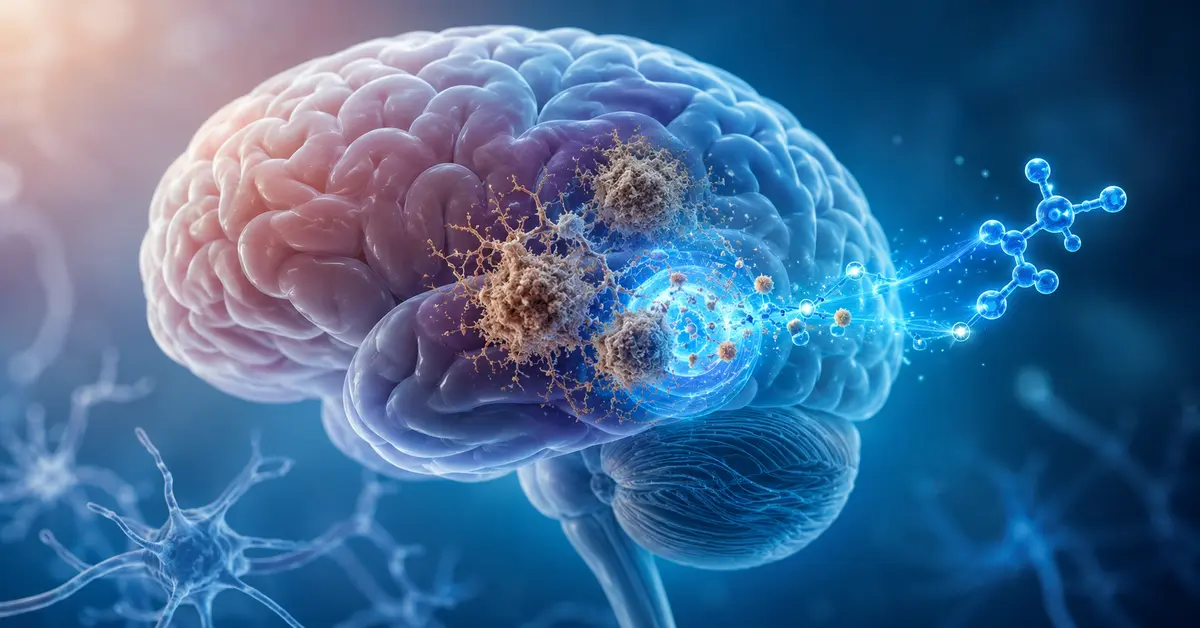
New compound for Alzheimer’s: could it stop amyloid plaques?
A new compound for Alzheimer’s is attracting attention because it targets one of the most studied mechanisms in the disease: the formation of amyloid beta and its buildup in the brain. The idea sounds simple – if harmful proteins do not clump together, plaques may not form. In reality, the science is more complex. Alzheimer’s disease cannot be reduced to a single protein, and experimental molecules must go through a long process before they can become real treatments.
What is amyloid beta and why does it matter in Alzheimer’s?
Quick answer: Amyloid beta is a small protein fragment that can accumulate between nerve cells and form plaques. These plaques are one of the main biological features of Alzheimer’s disease, together with tau changes and the loss of connections between neurons.
Several key changes are seen in the brain in Alzheimer’s disease. Among the best known are amyloid plaques, formed from amyloid beta, and tau tangles, which are linked to disrupted structures inside nerve cells. These plaques and tangles are considered central hallmarks of the condition, along with the gradual loss of neuronal connections.
Amyloid beta does not appear from nowhere. It is produced when a larger protein, called amyloid precursor protein or APP, is broken down. Under certain conditions, the resulting fragments can group together, form oligomers, and later develop into larger deposits. These early toxic forms and plaques are the focus of many therapies and experimental approaches.
How APP dimerization may trigger the problem
APP dimerization means that two molecules, or parts of amyloid precursor protein, bind together. Some research suggests that this process may influence how much amyloid beta is produced and what type of amyloid beta forms in the brain.
Dimerization matters because it occurs before the final buildup of plaques. If two parts of APP or its fragments connect in a certain way, this may change how enzymes cut the protein. Scientific literature discusses the relationship between dimerization of the APP fragment C99, gamma-secretase cleavage, and amyloid beta production.
This is where the potential value of the new compound comes in. Instead of waiting for amyloid beta to accumulate, the idea is to influence the process earlier. This is different from approved anti-amyloid antibodies, which target amyloid forms that have already been created.
What Professor Carmela Abraham’s team discovered
Professor Carmela Abraham’s team at Boston University searched for small molecules that could reduce amyloid beta production. A screening of tens of thousands of compounds led to interest in a molecule described as having kinase inhibitor activity.
Professor Carmela Abraham studies the biology of APP – the parent protein from which amyloid beta is produced. Her research has focused on APP, amyloid beta, and the molecular pathways that may contribute to Alzheimer’s disease.
A study in the American Journal of Neurodegenerative Disease describes an approach using high-throughput screening to identify molecules linked to APP dimerization and amyloid beta. Reports on the research note that the team screened about 77,000 molecules and identified a candidate described as a kinase inhibitor.
This does not mean there is a finished drug. Finding an active molecule is an early step. After that come studies on mechanism, toxicity, blood-brain barrier penetration, dosing, animal models, and clinical trials in humans.
What are kinase inhibitors?
Kinase inhibitors are compounds that block enzymes called kinases. These enzymes are involved in cell signaling, growth, inflammation, and other processes. In the Alzheimer’s context, the key question is whether a specific kinase affects APP and amyloid beta.
Kinases act like biochemical switches. They change the activity of other proteins through a process called phosphorylation. When a kinase is involved in an unwanted process, inhibiting it can become a possible therapeutic strategy.
In Alzheimer’s disease, this is especially delicate. The brain is a complex system, and kinases often have more than one function. A molecule may look promising in a cell model but later prove unsuitable in animals or humans. A strong candidate must not only reduce amyloid beta, but also be selective, safe, and capable of reaching the right place in the brain.
Could this compound prevent Alzheimer’s?
At this stage, it is more accurate to say that the compound may open a path toward a new therapeutic strategy. There is no proof that this specific molecule prevents Alzheimer’s in humans or that it can stop the disease on its own.
Headlines calling it “the key to preventing Alzheimer’s” sound powerful, but medical language must be more cautious. Alzheimer’s disease develops years before symptoms appear. It involves amyloid beta, tau, inflammation, vascular factors, metabolic changes, genetic risk, and aging.
Even when a therapy affects amyloid, that does not automatically mean the disease is fully stopped. Current anti-amyloid therapies show how complex the field is. Lecanemab and donanemab are examples of amyloid-targeting treatments intended mainly for early stages of Alzheimer’s disease, and they require careful patient selection and monitoring.
How is this approach different from approved therapies?
Approved anti-amyloid therapies target amyloid beta and plaques, while the experimental compound aims to influence an earlier process connected with APP and dimerization. This makes it an interesting, but still early, research direction.
Lecanemab and donanemab are monoclonal antibodies. They are large biological molecules given by intravenous infusion. These therapies are designed for specific groups of patients, usually in the early stages of Alzheimer’s disease, and require confirmation of amyloid pathology and medical risk assessment.
The candidate compound from Abraham’s research is different in concept. It is a small molecule, and its goal is to interfere with a process that may come before plaque formation. If this type of approach is proven, it could complement or differ from antibody-based treatments. For now, that remains a hypothesis until reliable clinical trial data are available.
Why this discovery matters
The importance comes from the fact that Alzheimer’s remains a major medical and social challenge. Every new molecule that helps scientists understand the disease mechanism may lead to better therapies, earlier intervention, or new diagnostic ideas.
Alzheimer’s disease continues to place a heavy burden on patients, families, caregivers, and healthcare systems. The need for earlier diagnosis, better treatment options, and more precise biological targets remains urgent.
That is why research on APP, amyloid beta, and kinases matters even when it does not immediately lead to a drug. It shows which biological pathways may be vulnerable. Sometimes a molecule never reaches the market but helps reveal a better target, a more selective inhibitor, or a new biomarker.
Risks of exaggerating scientific news
The biggest risk is presenting an early laboratory finding as a finished treatment. This creates unrealistic expectations for patients and families. The correct conclusion is that the research is promising, but still experimental.
In health topics, words matter. “May help” is not the same as “cures.” “Potential therapeutic target” is not the same as “approved medicine.” And “reduces amyloid in a model” does not automatically mean improved memory in humans.
That is why discoveries like this should be read through three questions:
- Was the research done in humans or only in laboratory models?
- Are there data on safety and effectiveness?
- Does it show real clinical benefit, or only a biological effect?
For the new compound discussed in this article, the careful answer is: scientifically interesting, but not enough to claim that it prevents Alzheimer’s disease.
Conclusion
The new compound for Alzheimer’s is a promising research lead because it targets processes linked to APP, dimerization, and amyloid beta formation. For now, however, it should be viewed as an early scientific possibility, not as proven prevention or treatment.
The real value of this discovery lies in the direction it points to. If scientists understand exactly how APP dimerization affects amyloid beta, more precise drugs may emerge. If a safe inhibitor is found that reaches the brain and reduces harmful amyloid forms, that would be a serious step forward.
Until then, the most reasonable message is balanced: science is advancing, amyloid therapies are already a reality for some patients in early stages, and new small molecules may become part of the future treatment toolkit. But no experimental molecule should be presented as a guaranteed “key” to preventing Alzheimer’s before that has been proven in humans.



latest video

news via inbox
Nulla turp dis cursus. Integer liberos euismod pretium faucibua